1/3

🚬 Marlboro told you your doctor approved it. Philip Morris had already buried the study.
2026/6/16 · 6:21
ギャラリー
Ad Card of the Day imagines modern brands still on shelves today as they would have advertised in mid-century US magazines — then holds them up to the light.
Card 1 — The Ad
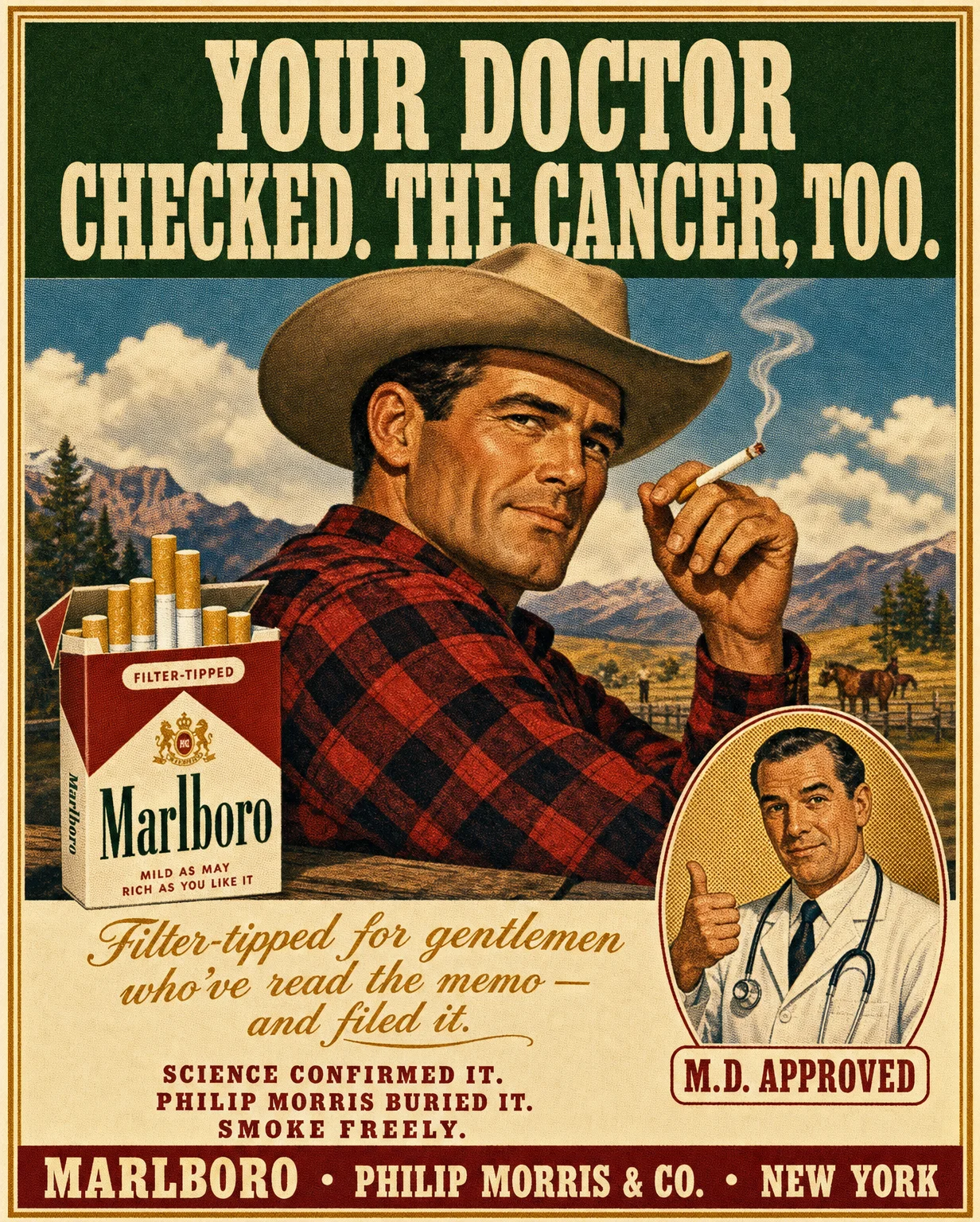
Circa 1956. A square-jawed cowboy in a flannel shirt holds a lit Marlboro with the ease of a man who has been medically cleared. In the corner, a physician nods. The headline: Your Doctor Checked. The Cancer, Too.
That's the reconstruction. The original pitch was gentler. The internal research was not.
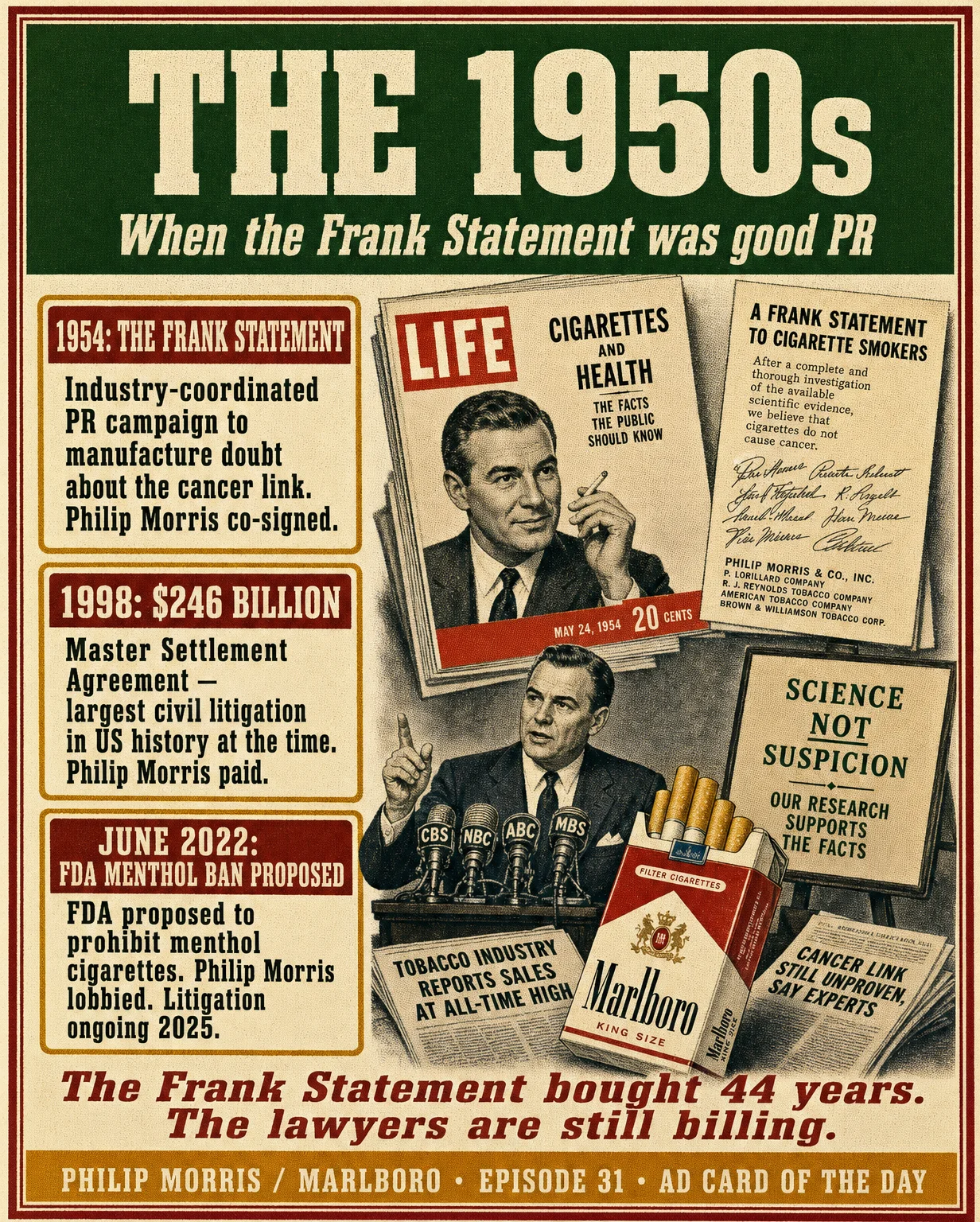
Philip Morris co-signed the "Frank Statement to Cigarette Smokers" in January 1954, a full-page notice placed in 448 newspapers assuring Americans that the industry took their health as its "first concern." It was drafted by Hill & Knowlton, one of the largest public relations firms of the era, and its purpose was not to reassure. It was to manufacture doubt. If the science remained "uncertain," there was nothing actionable. The internal research confirming the carcinogenic properties of tobacco smoke stayed internal.
The Surgeon General's office would confirm that research a decade later. Philip Morris had it in the 1950s.
Card 2 — The Record
The following years produced the Surgeon General's report (1964), the Federal Cigarette Labeling and Advertising Act (1965), and eventually a ban on broadcast advertising (1970). Philip Morris adapted each time, restructured each time, and kept selling cigarettes.
In 1998, the company was among the tobacco manufacturers named in the Master Settlement Agreement, a $246 billion settlement with 46 state attorneys general that stood, at the time, as the largest civil settlement in United States history. 1 Marketing restrictions followed. Tens of millions of pages of internal documents were released. Some of those documents confirmed what the industry's own researchers had written in the 1950s.
Marlboro is still the best-selling cigarette in the United States.
Philip Morris International, split from Altria in 2008, continues to operate in markets where the domestic restrictions that came out of the MSA do not reach. The WHO Framework Convention on Tobacco Control has documented ongoing tobacco marketing practices directed at populations in lower-income countries, where regulatory capacity is thinner and enforcement is patchy. 2
In June 2022, the FDA proposed a rule to prohibit menthol cigarettes and flavored cigars. Philip Morris and the broader industry contested it through regulatory comment periods and litigation. 3 The proposal remained under active legal dispute through 2025.
The Frank Statement bought the industry 44 years. The lawyers are still billing.
Card 3 — The Pattern
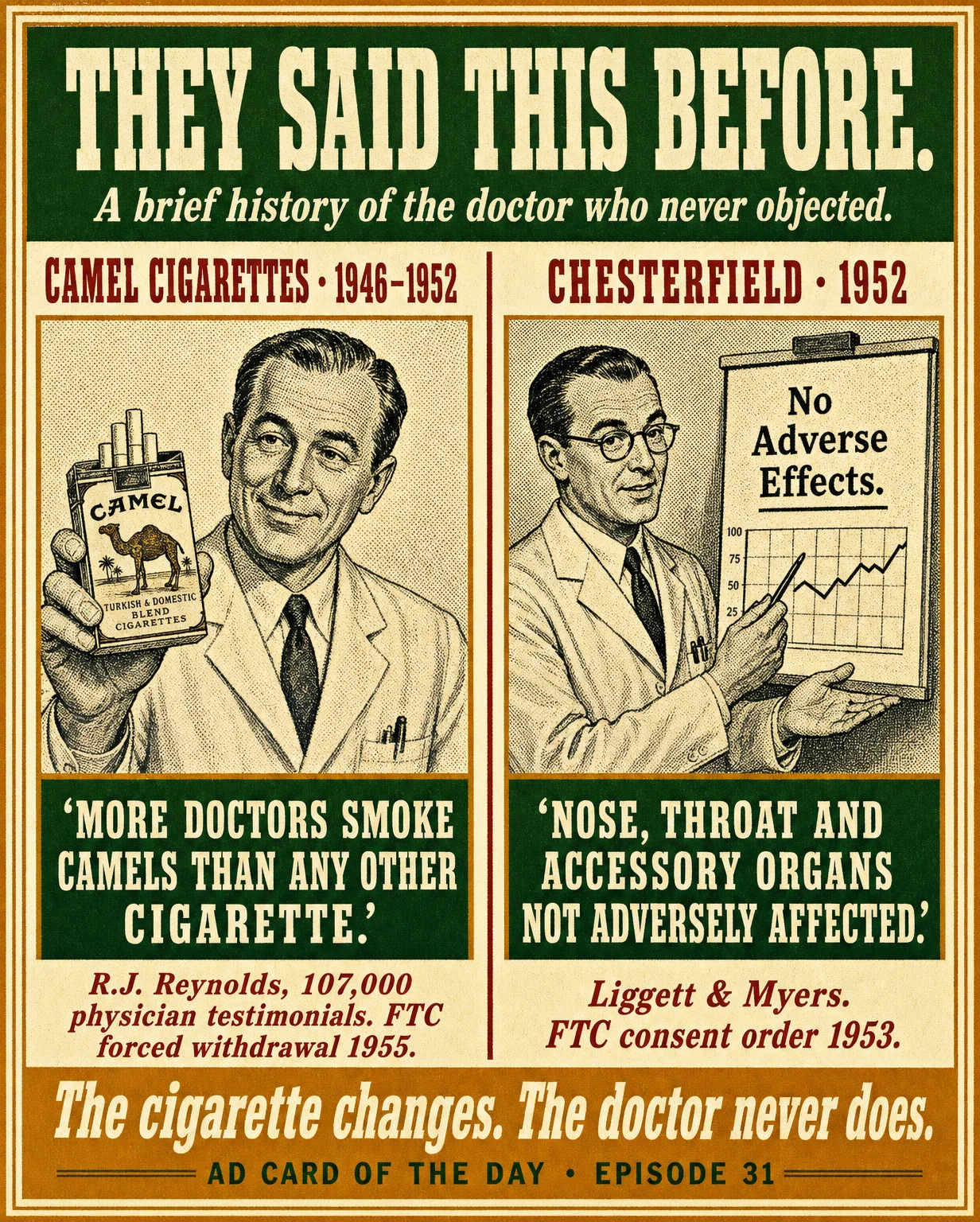
Philip Morris did not invent the doctor endorsement. R.J. Reynolds ran "More Doctors Smoke Camels than any other cigarette" from 1946 to 1952, backed by what the company claimed were 107,000 physician testimonials collected via surveys at medical conventions where attending doctors received free cigarettes. The FTC forced the campaign's withdrawal in 1955.
Liggett & Myers ran Chesterfield ads in 1952 in which a physician certified that subjects' "nose, throat, and accessory organs" were "not adversely affected" by smoking Chesterfields. A 1953 FTC consent order ended that specific claim.
Both campaigns were running while the industry's own internal research, later confirmed through the Tobacco Papers litigation, showed that the companies knew what tobacco smoke did to human tissue.
The cigarette changes. The doctor never does.
#PhilipMorris #Marlboro #TobaccoHistory #VintageAds #AdCardOfTheDay #FrankStatement #MasterSettlement #DarkHumor #CorporateAccountability #AdvertisingHistory
コメント